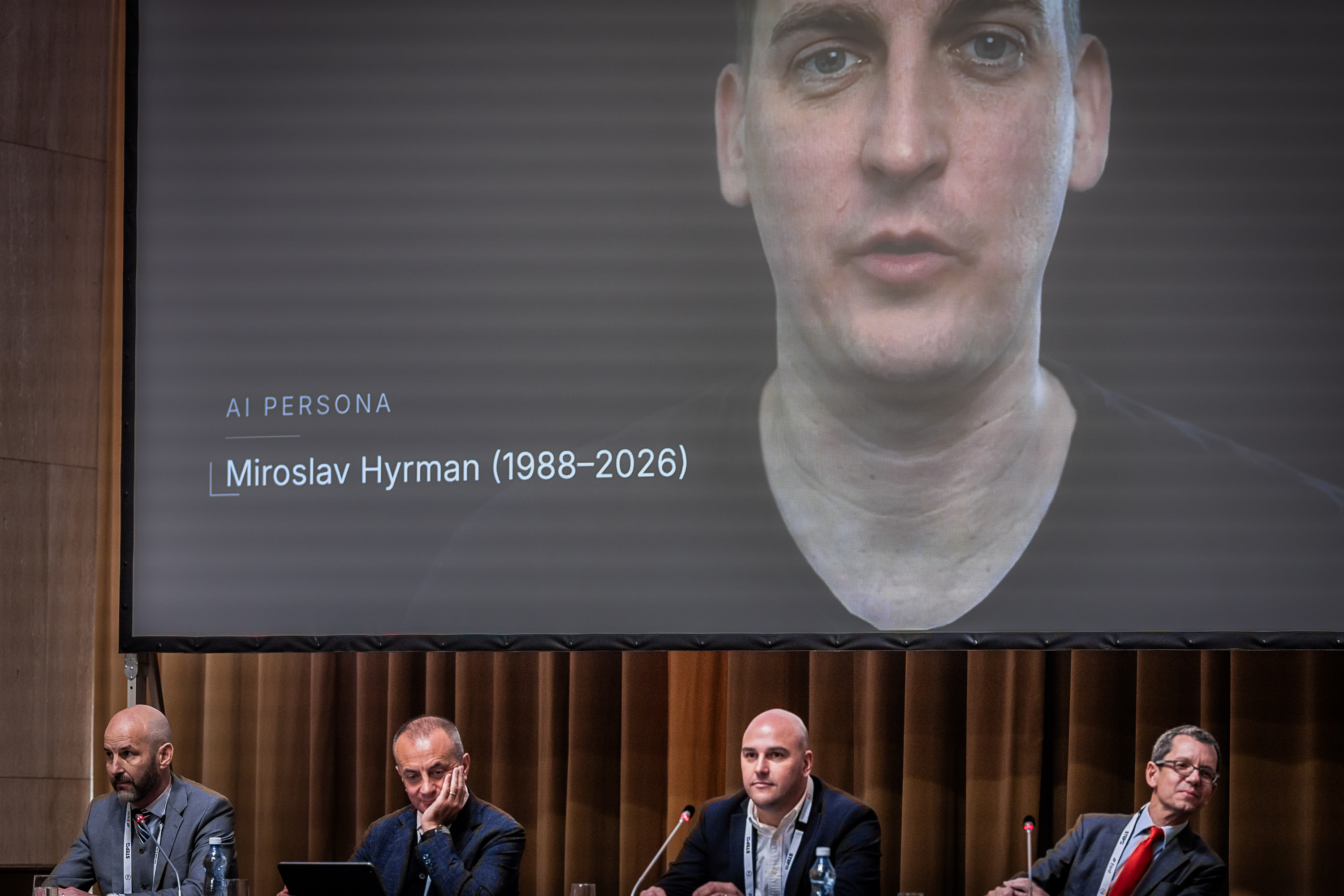
We Turned 180 Lawyers Into One Law Firm and Fast-Forwarded to 2030
The Workshops: Law Firm of the Future — Rethinking Legal Work with LegalOps & AI
On Friday, 23 October, Ondřej Dvořák and Miroslav Hyrman ran three back-to-back sessions of a workshop sponsored by YouTrack from JetBrains. The premise: before AI can truly improve legal work, law firms and in-house teams need to get their processes in order. The workshop introduced the basics of Legal Operations (LegalOps) and agile working methods adapted for modern legal teams, and showed through practical examples how connecting LegalOps, legal project management and AI improves matter coordination, automates routine work and builds more effective, AI-ready legal teams. Each session followed the same arc. Map a real workflow. Find the bottleneck. Then, and only then, plug in a tool.

Process first, AI second. Ondřej started with process mapping for matter management: how to organise matter-related information and turn it into structured, repeatable workflows. Participants worked through how they handle information at every stage, from intake to close. Most discovered their workflows existed only in people's heads.
Agile for lawyers. From there, the sessions moved to the practical tools of agile work, Kanban boards and task tracking, and to what they change for a legal team: who owns what, what is blocked, and what is done, visible to everyone without a status meeting.
Hands-on tech. Miroslav then moved to live tooling. He set up a board in YouTrack for Legal Teams for a sample M&A transaction, connected it to Claude and Microsoft Copilot, and ran the full workflow in front of the room: task assignment, status tracking, AI-assisted drafting, review loops. Forty minutes from empty board to working system.
The questions from the room circled around two problems. Pricing: how do you quote fixed-fee work when AI cuts drafting time by half? And delegation: how does a three-person team track who owns what without spending an hour a day on admin? Both have the same root. Without a structured process, you cannot measure what AI saves you. And you cannot price what you cannot measure.
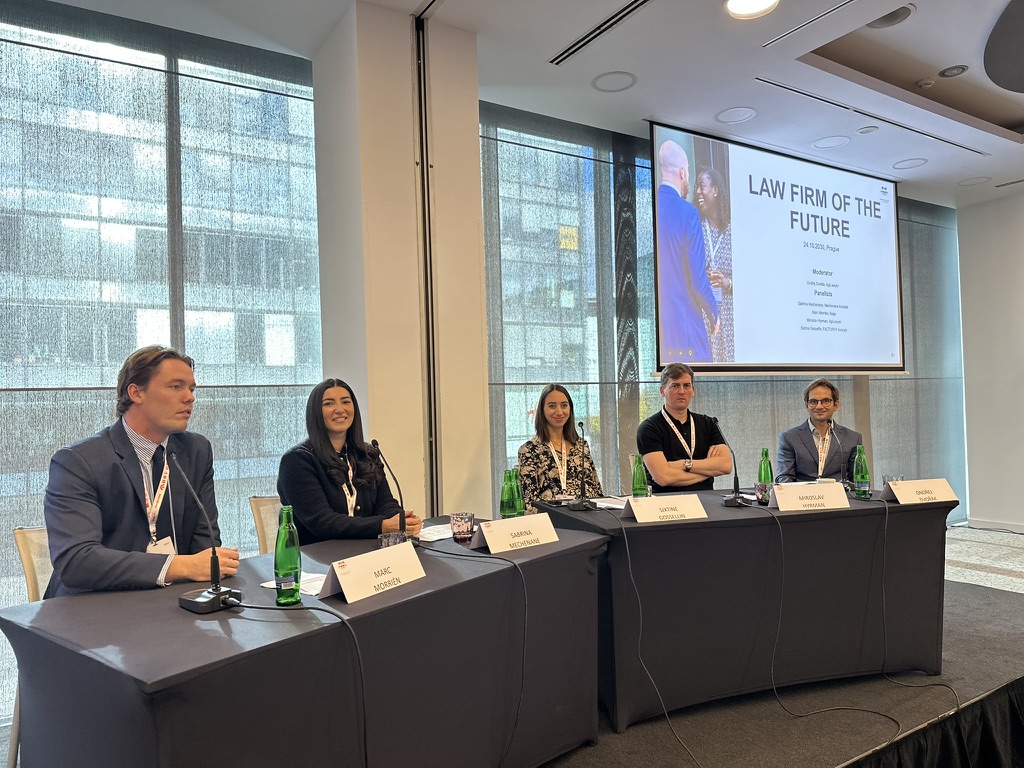
The Panel: The Law Firm of the Future
On Saturday, 24 October, Ondřej Dvořák moderated the joint session The Law Firm of the Future, asking what a successful law firm will look like in the age of AI, and who will lead it. The panellists were Marc Morriën (Saga, Netherlands), Miroslav Hyrman (AgiLawyer, Czechia), Sabrina Mechenane (Mechenane Avocats, France) and Sixtine Gossellin (Factor HY, France).
The format: it's 2030, and this room is a law firm
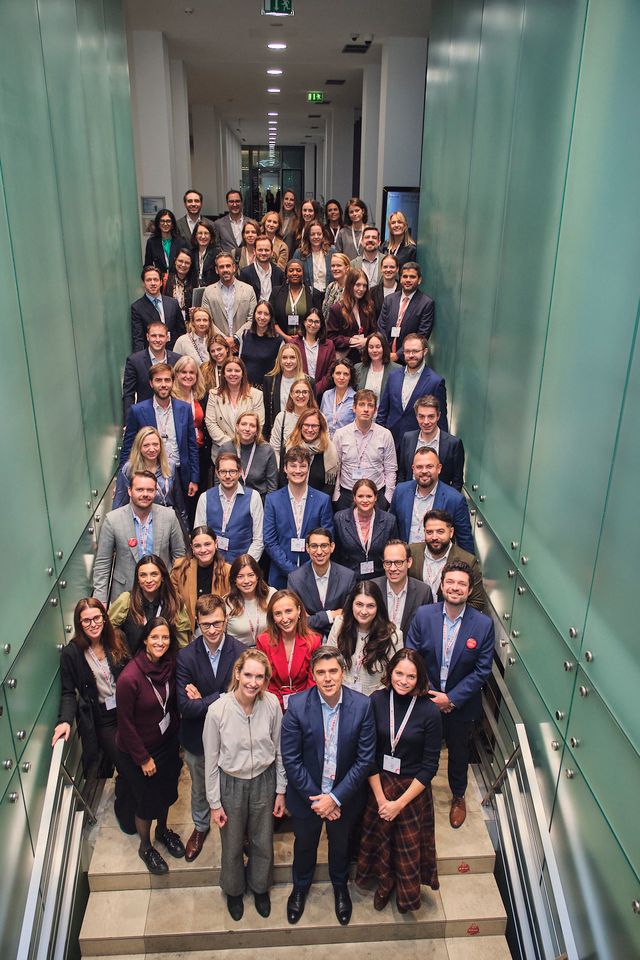
Instead of a conventional Q&A, the panel moved the room four years forward. The date on the screen read 24 October 2030. The 180+ people in the room became one law firm with €1M to invest, the panellists became its leadership team, and the audience voted live through five chapters: Clients & Growth, Operations & Pricing, People & Structure, AI & Data, and Leadership & Accountability. After each vote, the leadership team gave its perspective.
Fifty-three people joined the vote: 30 associates, 17 partners and 6 counsel.
The opening question set the mood. Has AI made your working life better or worse? 38 of 53 (72%) said better. Only 3 said worse and 5 said no different. But 7 (13%) chose a fourth answer: by 2030, they had left law.
Chapter 1: Clients & Growth
The room was almost unanimous that clients will not take advice on trust. 47 of 49 voters (96%) expect clients to check the firm's advice with their own AI by 2030. A smaller majority, 26 of 45 (58%), expect clients to find the firm through an AI assistant rather than a referral or a search.
Sixtine Gossellin brought the client perspective from her advisory work. Corporate legal departments are starting to ask firms for data on turnaround times and cost per matter type. Firms that track this can answer. Firms that don't are losing RFPs they would have won three years ago.
Chapter 2: Operations & Pricing
The pricing question was blunt: a task that cost the client €1,000 in 2026 is now 80% handled by AI. What should the client pay? 30 of 42 (71%) said the full €1,000. Ten said €500, two said €200, and nobody chose €50. The room is betting on value-based pricing, not cost-plus.
Marc Morriën described how Saga restructured its pricing after adopting AI drafting tools. Their fixed-fee contracts now include a clause specifying which parts of the work are AI-assisted. Clients asked for it. Transparency turned into a selling point.
Then came the question at the heart of AgiLawyer's workshops: do processes come first and AI second? The room split almost exactly in half, 22 yes and 23 no.
Sabrina Mechenane gave the "yes" side a concrete case. She introduced Kanban-style task tracking in her Paris firm two years ago. Her observation: the productivity gain came from the board, not from AI. AI added speed later, but only because the process was already clear.
Chapter 3: People & Structure
Asked which skill the firm hires for first in 2030, the room chose people over technology. Client relationships led with 23 of 51 votes (45%), followed by judgement (13), process thinking (8) and learning fast (5). AI and data literacy got 2 votes.
The pyramid question was the most one-sided of the day. 36 of 44 voters (82%) said the layer disappearing since 2026 is juniors. Five pointed to associates, two to counsel, one to senior associates. Nobody expects partners to go. That leaves an open question the panel kept returning to: if the junior layer disappears, where will the client-relationship partners of 2040 learn their craft?
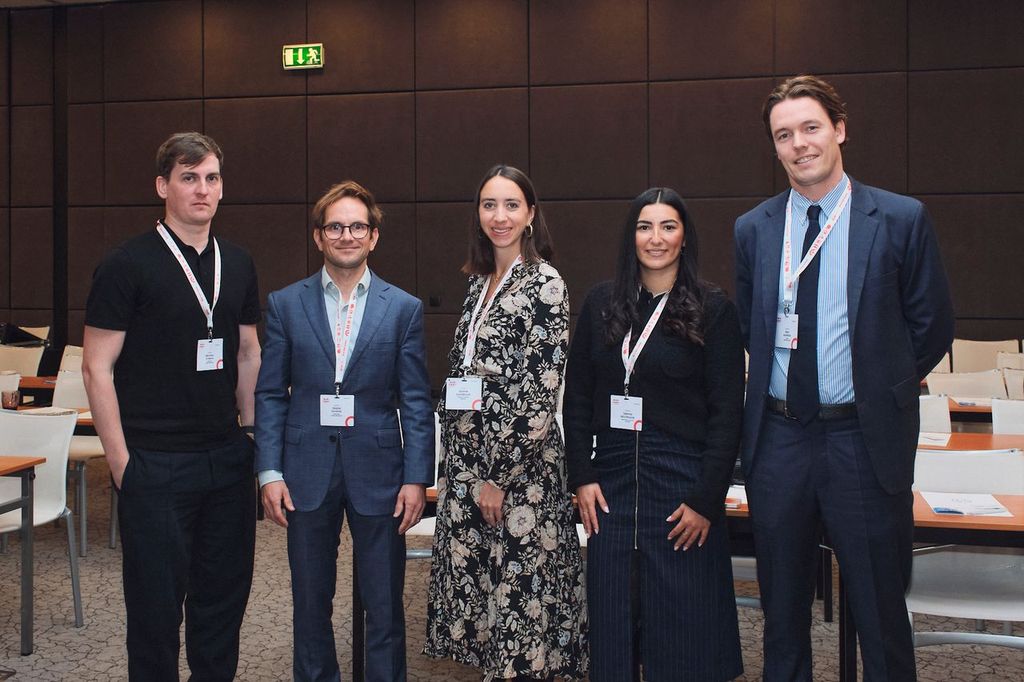
Miroslav Hyrman argued that the biggest gap is not technical. Lawyers who experiment with new tools weekly learn faster than those who attend a two-day AI training once a year. The skill is not prompt engineering. It is the habit of trying things and measuring what works.
Chapter 4: AI & Data
The room was sceptical of data-driven staffing: 32 of 45 (71%) said data does not decide who works on what in 2030.
On where to invest the firm's €1M, AI technology and training people tied at 14 votes each (33%). Process and LegalOps got 9, better data 6, and hiring more lawyers got none.
Chapter 5: Leadership & Accountability
Is the firm run by its best lawyer? The room split again, 22 yes and 21 no, an honest reflection of a profession still deciding whether leading a firm is a legal skill or a management one.
The final vote was the clearest of the session. When AI is wrong, is the partner who signs accountable? 40 of 41 said yes. Whatever changes by 2030, responsibility stays with the lawyer.
Questions from the audience

The audience sent in more than a dozen questions during the session. They asked whether firms should build their own AI tools or buy them, how to convince older partners to adopt AI, and whether firms might start hiring associates again if AI becomes more expensive to use. Others asked whether the pandemic left the profession better prepared for this shift, whether big law firms with high overheads and rates are under threat, and whether access to capital for expensive AI will favour large firms over small ones. One participant asked whether lawyers will move from giving advice to effectively insuring clients against the risks of AI-generated advice they obtain themselves. Another asked whether AI will shorten lawyers' working hours or simply raise the volume of work done in the same hours. And one pushed back on the pricing discussion: clients are used to paying for time, so perhaps hourly rates will rise to cover the cost of AI tools.
The panel closed with the most practical question of all: what is the single thing a five-person firm should do on Monday morning? Ondřej's answer: pick one matter type you handle often, write down every step from start to finish, and count the hours. That is your baseline. Everything else follows.
Reading the numbers
Taken together, the votes describe a profession that is optimistic about AI but has not yet settled how to work with it. The room expects clients to verify every piece of advice with AI, wants to keep prices where they are, and expects the junior layer to disappear. Yet it was split down the middle on whether process comes before AI, and only 9 of 43 voters would put the firm's money into process and LegalOps. Holding a €1,000 price for work that is 80% automated requires being able to show the client what the remaining 20% is worth. That is exactly what a measured, structured process makes possible.