Beyond the hype: an evening on AI with Buren Legal in Amsterdam
In-house lawyers from Buren Legal’s international network met in Amsterdam to talk about AI in legal practice: governance, the EU AI Act, the changing relationship with law firms, and what it means for the next generation. AgiLawyer’s Miroslav Hyrman was on the panel.
- Author
 Ondřej DvořákCo-founder
- Published
- Reading time
- 4 min
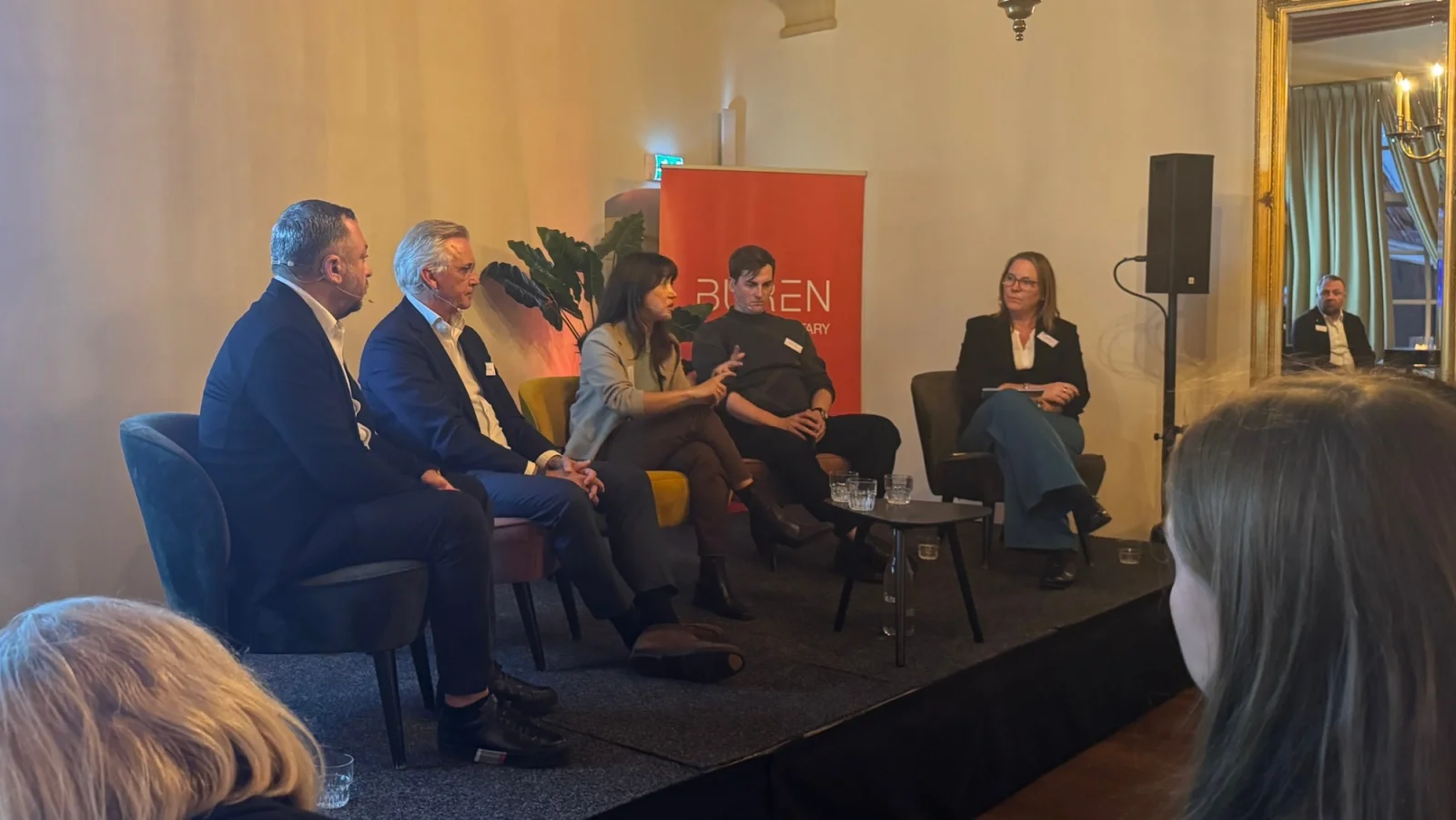
The setting
BUREN brings together an international community of in-house legal counsel. For its latest session it put AI on the agenda and five panellists on a stage under a wooden ceiling and a chandelier. The room was full. Friederike Henke moderated. The panel was Tim van der Maas, Kirill Lelchitskiy, Diana Sanclemente and AgiLawyer’s Miroslav Hyrman. Robin van Keeken and Michelle Bernsen organised the evening, and it ran smoothly from start to finish.
The audience was not made up of AI enthusiasts, and that was the useful part. Most people there use AI in some form already. Their questions were about how to choose the right tools, how to govern them, and how their work with outside counsel changes once both sides use them.
What was discussed
Regulation sets the frame
Start with the risk class, not the tool. One of the first slides showed the EU AI Act’s four risk tiers: unacceptable, high, limited and minimal. Most of what an in-house team uses day to day sits in the bottom two. That covers drafting help, summarisation, research and productivity tools. For those, the obligations are transparency, internal policies and respect for third-party rights such as IP and data privacy.
The picture changes when the business, rather than legal, deploys AI. The slide listed recruitment systems as high-risk, which surprised several people in the room. Many of them sit next to an HR function that is already testing such tools. The point for in-house counsel is that their AI work is not only about their own toolkit. It also covers what the rest of the company is rolling out.
Policies and governance
A policy nobody reads is not governance. A good part of the discussion went to AI policies. Most companies in the room have one, or are drafting one. Fewer have worked out who owns it, how it gets updated, and what happens when someone breaks it. The panel broadly agreed that a short, practical policy beats an exhaustive one. It works better when a named owner reviews it more often than once a year.

In-house and law firms
The billable hour meets the five-second summary. The relationship between in-house teams and their outside counsel came up again and again. If the in-house team can produce a first-pass analysis in minutes, what is it paying the firm for? The answer the panel kept returning to was judgement, accountability and context. That holds only if firms stop charging for the parts AI has made cheap.
The profession itself
Juniors learn by doing the work AI now does. This was the most open question of the evening, and nobody on the panel claimed to have the answer. If first drafts and document review move to machines, the training ground for young lawyers shrinks. Firms and legal departments will have to design that training on purpose instead of assuming it happens on the job.
What the room said it will do next
The session closed with a Menti poll: What is the first AI-related action you will take after this session? It wasn’t a scientific survey, but the answers are telling.
- “Buy Copilot” was by far the largest answer.
- “Increase use” and related answers such as using it more, keep using and more use when really need came next.
- Skills: prompting training, improve prompting skills and train juniors more for AI.
- Governance: focus on governance and copyright my prompts.
One answer proposed a staffing change involving a fellow panellist. We’ll leave that one between the audience and Tim.
The pattern matches what we see in our own work. When legal teams decide to “do something with AI”, their first instinct is to buy a licence. Training and governance come later, if at all. In our experience the order should be reversed. A Copilot licence in the hands of a team without clear use cases or prompting skills becomes an expensive search bar.

Our take
Process first, tool second. The tools are good enough now, and they are getting better fast. What separates teams that get value from AI from those that don’t is rarely the vendor. It is whether they know which of their processes are worth changing, and whether their people are trained to do it.
Friederike closed the panel by saying that many questions remain open and that the answers will keep changing along with the technology. We agree. That is why the response has to be a habit of experimenting, measuring and adjusting rather than a one-off purchase.
Thank you to BUREN and Friederike for the invitation, to the panellists for an open and honest discussion, and to everyone in the audience who asked the hard questions.